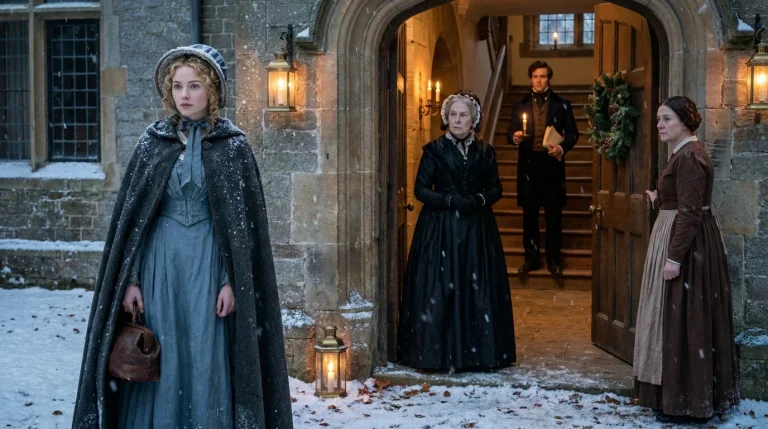
Avis took the little sewn book from her apron pocket and laid it on the schoolroom table.
“I am not saying where the other eight go. I am saying they do not reach the river.”
He looked at the book for a long time without opening it.
“Come to the estate office tonight, when Tabitha is in bed,” he said. “Bring this. I want you to show me.”
That was the first of the Thursdays. The estate office was at the end of the ground floor, beyond the gun room: a plain, square room with a long oak table and shelves of account books going back to the late Duke’s grandfather. Mr. Crowe kept his own office across the courtyard and went home to the village at six, so by nine the estate office was always empty and cold. The Duke had the fire made up. He sat on one side of the long table and she on the other, with the candles between them and the ledgers open, and they began.
She found the first thing on that first night. The estate ledger showed forty pounds a year paid to the school in four installments of ten pounds, all in Mr. Crowe’s fine clerk’s hand. Beside the quarterly school allowance was a second entry: slates, books, and school supplies furnished by Messrs. Hargrave and Company of the Side, Newcastle, two pounds each quarter for six years.
“Three slates,” Avis said. “In six years.”
The Duke put a finger on the entry.
“It is possible the school’s ten pounds includes the supplies, and Miss Lowe receives the remainder.”
“Then why is it entered twice? Ten pounds paid, and two more paid for goods never received?”
She ran her finger down the column.
“I shall say nothing until I have seen the invoices themselves, Your Grace. A clerk may enter something twice by mistake. He cannot invent a tradesman by mistake.”
On the second Thursday she found the Bells: relief to Robert Bell, tenant, at Michaelmas, on account of an injury at harvest, two guineas, received by his mark. Four lines below, in the same week: repairs to R. Bell’s cottage, thatching, paid on order, two guineas.
“They were refused relief,” Avis said quietly. “Mr. Bell’s grandson told me, and so did Miss Lowe. And that cottage has not been thatched since the late Duke’s time. I have seen it. The rain comes in above the bed.”
The Duke leaned back in his chair. For a long time he said nothing. The fire shifted. Outside, a fox barked twice in the frozen park.
“My brother trusted Crowe absolutely,” he said at last. “So did my father before him. When I came home, Crowe was the only man in the county who knew where anything was. He sat with me every morning for three months and went through every book in this room. I was grateful to him. I am still grateful.”
He rubbed his eyes.
“Do you understand what you are asking me to believe?”
“I am not asking you to believe anything, Your Grace. I am asking you to look.”
It was that night he told her about Gervase. He had been the younger son. His brother had the land, the title, and temperament enough for two. Piers had gone to London at twenty to study law and had been, in his own words, a perfectly decent barrister for eleven years. He had liked it. He had liked arguing other people’s cases in a warm courtroom and going home in the evening with no troubles but his own.
Then typhus came to the valley in the autumn of 1822. It took the late Duke’s steward, two farm families, and then Gervase. Four days later it took Celia, his wife, who had nursed him. Tabitha was eight. Piers came up from London by the mail coach to find two coffins in the hall and a child who would not let go of the banisters.
“I was trained to cross-examine other people’s witnesses,” he said, looking into the fire. “I could take a liar to pieces in a quarter of an hour. I came home and could not read my own house. I still cannot. Every morning I sit here and put my name to things I do not understand, because the man who does understand puts them before me and says, ‘This is what your brother would have done.’”