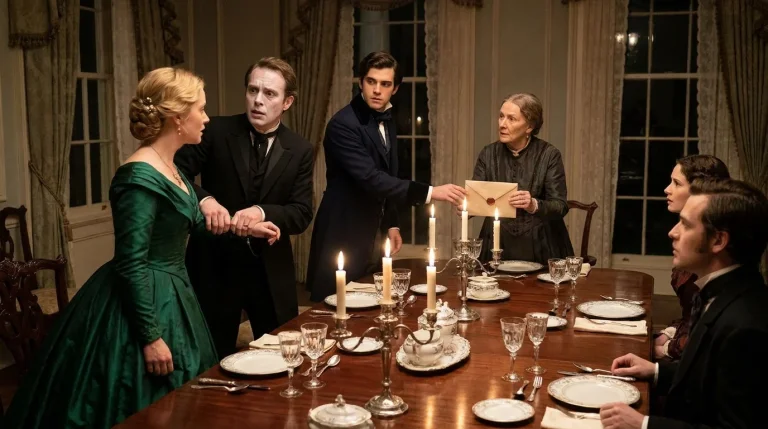
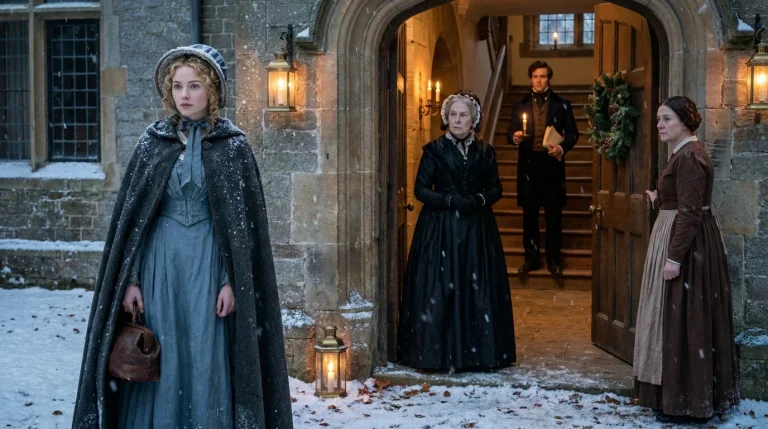
She played every evening after that, with the schoolroom door ajar. Nothing grand, only pieces from her father’s songbook: old psalms, country airs, and the little rounds he had written for the children at his school. She played softly, for this was a house of whispers, and did not look toward the door. On the sixth night, she heard the third stair creak. On the ninth, the creak came closer and stopped. By the end of the second week, a small figure in a white nightgown sat on the landing outside the schoolroom door, knees drawn beneath her chin, every night until the last note.
On the fifteenth night, Avis played the old Northumbrian air, “The Water of Tyne,” and deliberately played a wrong note at the turn of the second line.
“That is wrong.”
The voice came from the doorway. It was small and hoarse, like a hinge that had not opened in a long time. Avis did not turn. She played the line again, making the same mistake in the same place.
“It goes up there. It does not go down.”
The voice was nearer now, and indignant.
“My mother used to sing it. It goes up.”
Avis took her hands from the keys.
“Will you show me where?”
There was a long silence. Then a small, cold hand reached over her shoulder and pressed a key firmly, as though crushing a beetle.
“That one.”
“Thank you,” Avis said, and played the note correctly.
When she finished, the doorway was empty. The next evening, however, Tabitha came all the way into the room and sat at the end of the bench beside her. After a quarter of an hour, she spoke very quietly.
“Mama let me turn the pages.”
Mrs. Elsdon heard of it from the nursery maid. The next morning she came to the schoolroom, ostensibly about the coal, and stood a moment on the threshold watching the child over her copybooks.
“She spoke,” the housekeeper said. “In the night. She spoke to you.”
“She told me I was playing something incorrectly,” Avis said. “She was quite right.”
Mrs. Elsdon looked at her for a long moment. Then she went away. That afternoon a second scuttle of coal arrived in the room at the end of the west corridor without anyone having asked for it. One came every day afterward.
The second friend Avis made at Coldmarten was Thomas Bell, the head gardener, who had worked on the estate for fifty-one years and had opinions about everything that grew there, including the family. He was a stooped, weathered man who spoke slowly and had hands like roots. He began leaving things on the schoolroom windowsill: a sprig of winter jasmine, a paper bag of three late pears, and a bowl of hyacinth bulbs forced in the greenhouse for the little girl. He never once said they came from him. Avis never once asked.
It was Thomas Bell who drove her and Tabitha to the charity school in the cart during the second week of December, because Avis had said in his hearing that a child who had stopped learning from books could sometimes learn again from other children. The school stood by the river at the foot of the village, a long, low building of gray stone with a bell on the gable. The old Duchess, Piers’s mother, had founded it in 1797 so that the estate children might learn to read their Bibles, write their names, and do enough arithmetic not to be cheated at market.
There were thirty-one children on the benches and only three slates among them. The schoolmistress, Miss Keziah Lowe, was a thin, brisk woman of thirty, with chilblained hands and a voice that could stop a bolting horse. She flushed when she saw who had come, and more deeply when she saw Avis looking at the empty grate.
“We have coal on Mondays and Thursdays,” she said. “On the other days, the children bring a stick each if they have one. I asked Mr. Crowe for more, but he said the allowance is the allowance.”
“What is the allowance?” Avis asked.
“Eight pounds a quarter for everything. Coal, books, slates, the roof. My salary comes out of it.”