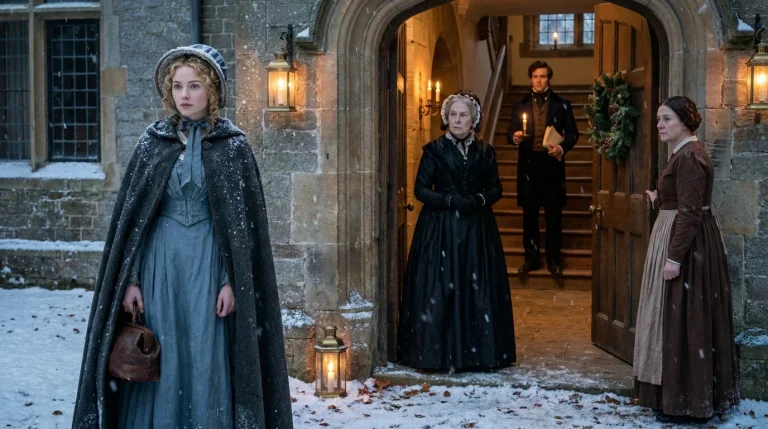
“I gave money for it. My own.”
“Would you do it again?”
She knew the right answer. She had known it for five months.
“Yes.”
“That is a very poor answer for a woman seeking employment.”
“It is the only honest answer I have, Your Grace. I thought it better that you should have it now than discover it afterward.”
Then he looked at her, truly, for the first time. Something crossed his face that was not quite a smile. He asked what she could teach. She answered: music, pianoforte and singing, French, history, geography, and the use of the globes.
“And accounts,” she added. “I kept Lady Tyndall’s household books for two years. She did not like figures.”
“My niece is ten,” the Duke said. “She has not touched the instrument since her mother died, and she does not speak to strangers. The last governess left in September because Tabitha had not spoken to her in four months. I can offer you forty pounds a year. It is less than you are worth, and a little more than this estate can easily afford at present.”
Avis opened her mouth to answer and found nothing to say.
“Mrs. Elsdon will show you,” he said. “I have a room for you.”
It was such a small thing: six words spoken in the tone a man used to discuss the weather. But she had spent five months being looked at through half-open doors. She had stood on steps in the rain while women decided she was unfit to sleep beneath their roofs. She had counted her shillings every night upon Mrs. Stott’s coverlet and divided them by the number of days. In all that time, no one had offered her anything without first making her prove that she deserved it.
Her hands began to shake. She put them in her lap, and they shook there. She tried to say thank you, but her throat closed on the first word. She pressed her lips together and stared hard at the fireguard, because she did not want, she absolutely did not want, to cry before a duke in his own library on the first night. He saw it. She knew he had seen it.
He did the kindest thing anyone had done for her in six months. Without a word, he rose, crossed to the window, and stood looking at the black glass with his hands behind his back, as though something in the dark garden required his entire attention.
“It is at the end of the corridor,” he told the window after a moment. “It looks over the orchard. It is not grand. The chimney draws well.”
“Thank you, Your Grace.”
She had recovered her voice, more or less.
“You may thank me in a month, Miss Tennant, if you still wish.”
He did not turn.
“I should tell you that I do not yet know whether you are telling the truth. I only know that no one appears to have troubled to find out. That seems a very poor reason to send a woman into the hail.”
The room at the end of the west corridor had whitewashed walls, an iron bed, a fire someone had already lit, and a steaming jug of hot water on the washstand. Avis closed the door, sat on the bed in her soaked cloak, buried her face in her mended gloves, and at last wept, as quietly as she could, for a long time. Then she slept for eleven hours.
She had been at Coldmarten a week when Lady Griselda gave her first dinner of the winter. The rector came, the Reverend Samuel Price, a stout man, accompanied by his wife. Mr. and Mrs. Selby came from Biddlestone. Mr. Nathaniel Crowe, the estate secretary, dined with them as he did when a sixth gentleman was needed at table. He was a neat, quiet man of forty-five, with beautiful hands, who had served the family for twenty-three years. He was the only person in the house who had taken the trouble to be pleasant to the new governess. He had shown her the schoolroom himself and asked very politely whether she needed anything.
After dinner, Lady Griselda sent for her.