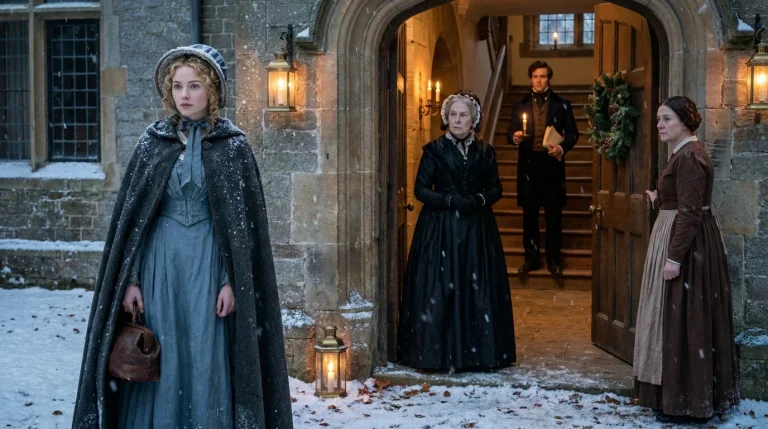
“The trust accounts,” Avis said. “The full accounts. Mr. Crowe sends the trustees a certified copy every Lady Day. You must have them here.”
He had them. They spread six years of certified copies upon his table, and she followed them with her finger as she had followed the ledgers on Thursday evenings in the estate office. At last she stopped.
“There. Mr. Crowe’s expenses. Journey to Newcastle on estate business. Eight shillings. It is the Wednesday after every quarter day. Every quarter, for six years.”
She looked up.
“His Grace went to the bank to ask on what day the Hargrave drafts were cashed. I will wager anything, Mr. Ellison, that it was a Wednesday.”
The solicitor looked at the column for a long time. Then he took off his spectacles and wiped them, which, as Mrs. Stott afterward told her, was the most obvious sign of excitement anyone in Morpeth had ever seen in him.
She was at her table that evening, writing to Captain Heddon, when Mrs. Stott came upstairs with an odd expression to say that a young lady below, in a carriage, was asking for Miss Tennant. Lady Beatrice Tyndall stood in the doorway of the little room above the saddlery in a fur-trimmed pelisse. She was thinner than the previous summer and held her chin high, exactly as she had on the night Avis turned the key in her door.
“I turned twenty in February,” she said before Avis could speak. “My mother’s money is mine now. I live with my aunt in Edinburgh, and my father cannot reach me.”
She swallowed.
“He had a letter two weeks ago from a Mr. Crowe at Coldmarten, asking him to give your character in writing. I read his answer before it was sealed. I know what he wrote about you. That is why I have come.”
Avis found she had stood up. She also found that she had been waiting nine months to say something, and it was not what she had thought she would say.
“You left me to carry all of it. Alone. You stood in your father’s hall and said nothing while he told them I had done it for money.”
“Yes.”
Lady Beatrice did not look away.
“He told me that if I spoke for you, he would have Dr. Haddo certify me mad and send me to Gateshead Asylum. He had the papers drawn up. He showed them to me. I was nineteen, and I believed him.”
Her voice shook, and she steadied it.
“I know it is not enough. I have known it every day since.”
Avis sat down slowly.
“I know you were frightened. I knew it then. I still wish you had spoken.”
“So do I.”
Beatrice came into the room and put a folded paper on the table.
“It is a sworn statement, made before a notary in Edinburgh, of everything that happened on the night of June twelfth, and why. I will say it aloud wherever you wish, before whoever you wish. My father may say what he pleases.”
Then, more softly, she continued.
“There is something else, and you are free to refuse it. My aunt and I mean to open a school for girls in Edinburgh with my mother’s money. We want a music mistress who will teach them that a door can be opened from the inside. The post is yours if you want it. A salary, rooms of your own, and no one’s permission required.”
Avis looked a long time at the paper on her table. All her life she had wanted something like it: a place that was hers because of her work, which no one could take away by shutting a door. There it was on her own table, written by a frightened girl. It had come in the same week that her heart had been left on an oak table twenty kilometers away. She was not foolish enough to think she could have both on her own terms.
The Duke came on Friday evening. First she heard the horse in the street, ridden hard. Then Mrs. Stott’s scandalized voice on the stairs. Suddenly he was in her doorway, rain running from his hat and his coat black to the shoulders. He had come straight from Newcastle, gone to Coldmarten, been told at his own door, and turned his horse in the yard.