Avis found her an hour later in Coldmarten’s cold music room, sitting beside the closed instrument in the dim light.
“I have not come to triumph,” Avis said from the doorway.
“I know.”
Lady Griselda did not turn her head.
“Do you know why I believed him? Because in forty years he was the only person in this house who ever asked my opinion. He came every week and asked what I thought should be done. No one else ever did. Not my brother, nor his sons. I kept this house standing through two funerals, and I was nobody in it.”
She was silent a moment.
“You will think that is what I did to you.”
“It is what you did to me,” Avis said. “I know it was done to you too.”
Lady Griselda stood and shook out her skirts.
“You will need the household books. Linen, silver, stores. I shall put them in order for you. I will not pretend to like you, but I shall not be petty about the accounts.”
She passed Avis with her chin high and did not cry until she reached her own room. Avis stayed alone in the music room, finding, to her great annoyance, that she felt sorry.
They were married at the end of June in the parish church, with the Reverend Price officiating and Tabitha turning the organist’s pages. Thomas Bell saw to the flowers and said they were not good enough. Miss Lowe wore a new hat bought with her new salary. Mrs. Elsdon cried from the first word to the last and denied it afterward. Lady Griselda sat in the front pew, very straight. At the wedding breakfast she was heard to tell the Bishop of Durham that she had always thought highly of the bride.
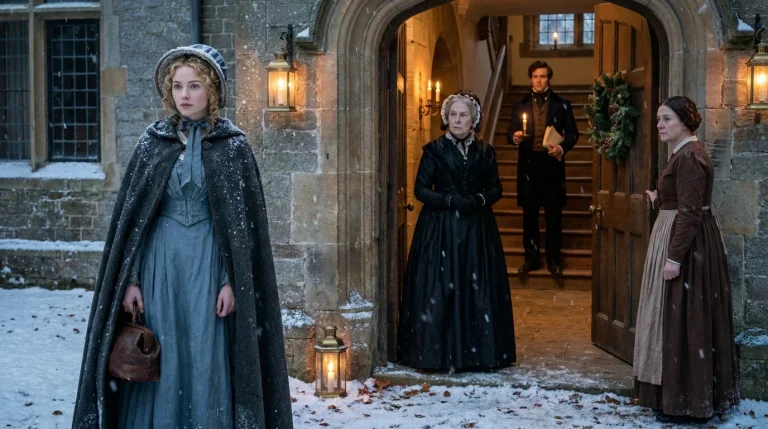
Seventeen months later, on a wet November night, someone knocked at the kitchen door of Coldmarten Hall. Mrs. Elsdon went with her keys at her waist. On the step, in the sleet, stood a young woman clutching a traveling bag to her chest, her gloves mended at every fingertip. She said she had been turned away from four houses that week. She had been a governess in Durham, dismissed without cause, and had walked from Rothbury.
“And who will speak for you?” Mrs. Elsdon asked out of long habit.
Then she stopped, looked at the girl’s gloves, and did not close the door. The Duchess of Coldmarten was in the passage behind her, carrying a lamp on her way to the schoolroom, because Tabitha had a new piece to learn and liked to practice at night. She came to the door and looked a long time at the young woman on the step: at the wet bag, the mended gloves, and the face above them, the face of someone who had counted her shillings and divided them by the number of days.
“Come in out of the sleet,” Avis said. “You can tell me the rest beside the fire.”
Then, because she knew exactly what it would mean, she said it simply, in the same way it had once been said to her.
“I have a room for you.”
It was at the end of the west corridor. It overlooked the orchard. It had whitewashed walls, an iron bed, and a fire had been lit in it every evening for two years, because the Duchess had given the order and no one in that house had thought to ask her why.