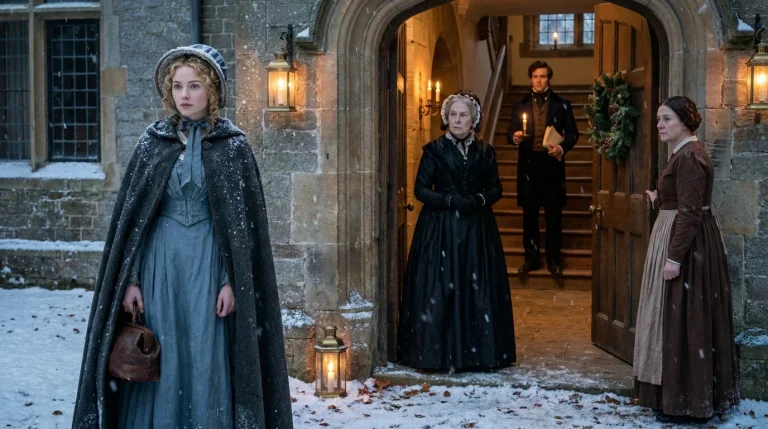
He set her down at Thropton Bridge. She walked the last six kilometers. Sleet stung down from the Cheviots, and she went on with her head lowered and her bag against her chest, forbidding herself to think what she would do if this door closed too. There was nothing beyond that door. She knew it. She had counted her shillings.
It was quite dark when she rounded the last bend and saw Coldmarten Hall on its rise above the river: a long gray house, almost unlit, like a house that had been told to wait and had forgotten what for. She went to the kitchen door, because that was where a woman without a character went. The housekeeper who opened it was tall and thin, with keys at her waist and a face that had been closed for years. She listened to Avis on the doorstep in the sleet. At last she asked the only question that mattered.
“And who will speak for you?”
“No one, ma’am.”
“Then I regret your journey.”
Mrs. Elsdon began to close the door. Behind her in the passage, a second woman had appeared: gray-haired, very straight, dressed in black silk with a lace cap and carrying an ebony cane she did not seem to need. Lady Griselda Heddon, the Duke’s aunt, had governed Coldmarten through two years of mourning. She looked at the soaked young woman on the threshold like a magistrate examining a petition.
“Now,” she said, “I know that name. You are the Tyndall woman.”
“I was in Lord Tyndall’s service, my lady.”
“You helped his daughter escape through a window.”
Lady Griselda said it without animosity.
“We have a child in this house who lost her mother less than two years ago. You will understand why I do not wish her to be educated by a woman of that reputation.”
Avis was ready to curtsy and go. Then she discovered that she was not ready after all.
“I did not help her through a window, my lady. I unlocked a door. It was a door that should never have been locked.”
The passage became silent. Somewhere a clock ticked, and hail rattled on the step. Then a man’s voice came from the turn of the service stair, low and calm, as though he had been standing there for a while.
“Which door?”
She looked up. He stood three steps from the bottom, in a dark coat, with a candle in one hand and a sheaf of papers in the other, as though he had come downstairs on some private errand and forgotten it. He was tall and lean, with short brown hair and a face that looked as though it had not known rest for a year. She knew at once who he must be, for no one else in that house would have dared interrupt Lady Griselda.
“Your Grace,” Mrs. Elsdon said.
“Which door, Miss Tennant?” Piers Heddon, Duke of Coldmarten, repeated. “Not whether you unlocked it. Which one, and why?”
Ten minutes later she found herself in a library that smelled of cold ashes and old leather, dripping upon an Oriental carpet, telling a duke what she had told no one. He did not sit before she did. He listened without interrupting.
Lady Beatrice Tyndall was nineteen. Her father had promised her to Sir Hamon Gryce, a man of fifty-eight with two dead wives and a great deal of coal beneath his land. Beatrice had refused. Her father had locked her in her room for eleven days. On the twelfth night, the night before the contracts were to be signed, Avis had taken the key from its hook in the study, where she had been told it must remain. She had unlocked the door and given Beatrice the fare for the coach to Edinburgh and the name of the inn in Belford where it stopped. Beatrice had been caught in Belford before dawn and brought home in her father’s carriage.
“And she did not clear your name,” the Duke said.
“No, Your Grace.”
“Why not?”
Avis looked at the cold grate.
“That is hers to tell. Not mine.”
He was silent for a moment.
“Did you take money for it?”