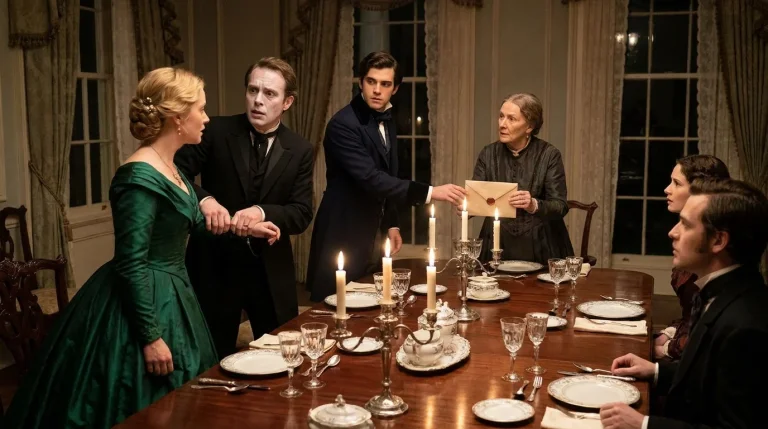
“I have said nothing this morning because it was not mine to say. Miss Tennant found every figure you have heard. She found them while teaching my niece to play again, and was sent out of my house for it, in my absence, without a character. I believed Mr. Crowe for two years because he was the only man who seemed to understand my brother’s books. I should have asked why.”
He looked around the table.
“Mr. Price, you are a magistrate. I cannot sit in judgment upon my own servant.”
The Reverend Price, who had never raised his voice in his life, ordered that Mr. Crowe be detained for examination before the Morpeth magistrates. He sent James Bell to fetch the constable. While they waited, Mr. Crowe stayed at the end of the table with his beautiful hands folded upon the ledger. He spoke once to Avis alone, so quietly that only she and the Duke heard.
“Your father asked the same questions. I was twenty-two. I carried his letters to the old secretary and saw what they did to him for asking. I learned that night what honesty costs in this county.”
“So did I, Mr. Crowe,” Avis said. “I learned it at Tyndall. I simply chose to go on paying.”
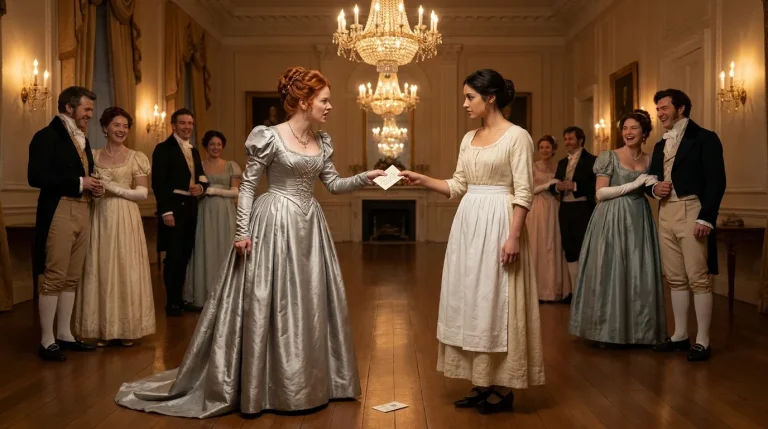
When the constable had taken him away, Lady Griselda Heddon rose from the trustees’ table. She was very straight and very pale. She took a folded paper from her bag, crossed the room, and gave it to Avis before everyone.
“I wrote this at six this morning, before any of this, because I had already gone through the estate office myself after you left, found what you had found, and understood what I had done. It is a character, Miss Tennant. It states that you are honest, capable, and kind to children, and that you were dismissed from my nephew’s house through my own error and an unjust suspicion.”
Her mouth trembled a little.
“It is late.”
“It is true.”
Avis took it. For a moment she could say nothing. Then, from the front bench, a small, hoarse voice spoke.
“Now.”
Miss Lowe, who had been warned, raised her red hands. Thirty-one children and one little girl with black ribbons stood and began to sing “The Bell on the Gable” in three parts, as John Tennant had taught it in that room twenty-eight years before. Tabitha sang louder than anyone. She had not stopped speaking after all. She had only been saving herself.
The Duke waited until the room was quiet again. Then he came down from the trustees’ table and stood before Avis in the school where her father had taught him to sing.
“I asked you in a room you paid for yourself,” he said. “I ask you again in a room you have walked into on your own feet, with your own work upon the table. Avis Tennant, will you have me?”
She thought of it, and it took less time than thinking of a school in Edinburgh, rooms of her own, and the hundred pounds a year no one could take from her. She thought she would have a home for the rest of her life, one way or another. She was good at her work, and that part belonged to her alone. But there would only ever be one man like him.
“Yes,” she said, “with conditions. I shall say them here, so no one need invent them later. I will not marry you because you offered me a room when I had nowhere else to go. I will marry you because I love you, and because you listened before you believed. I shall be a trustee of this school in my own name, not as your wife. Miss Lowe will have sixty pounds a year from Lady Day. And I shall go on teaching. Anyone who is ashamed of it on my account may dine somewhere else.”
“Very well,” the Duke of Coldmarten said. “I agree to all of it.”
“And Lady Beatrice shall still have her music mistress for Edinburgh,” Avis added. “I know exactly the right person. She is in Morpeth, and she has eleven pupils.”
He kissed her before the whole parish, which was spoken of in the valley for forty years by people who had not even been there. Lady Griselda left the school while everyone crowded around the couple, and no one noticed her going. That was the worst of it for her. Not that anyone was unkind, but that no one looked at her.