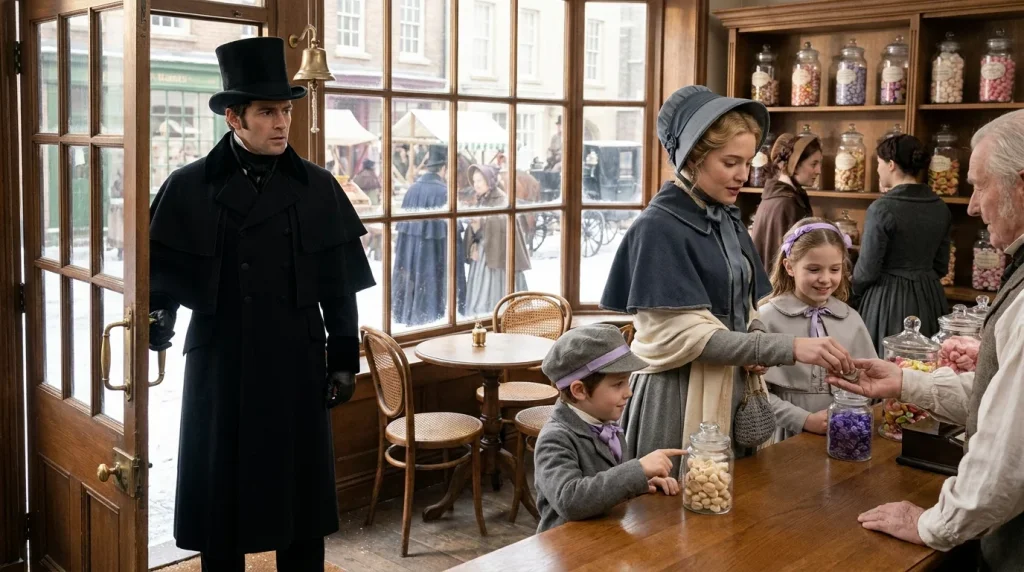
The bell over the door had not stopped ringing, and I was already on the pavement with my back to Salisbury market and my face to the glass. I do not remember stepping backwards. I remember the stones beneath my boots, the wheels beside me, and the fact that nobody came near. On the other side of the glass, she had not moved. My children’s governess was looking at me.
There was no appeal in her eyes and no apology, only the quiet attention of somebody who had just watched a man turn white in front of most of a shop and had no intention of pretending she had not seen it. I looked into those eyes longer than a gentleman ought to look into the eyes of his employee. I could not do otherwise. I was the Duke of Penmar, a widower of two years, and I had just walked into a confectioner’s shop and stood speechless in front of everybody.
Anyone in that square would have said it was scandal that stopped me. That would have been easier to bear. A scandal can be put down with a name and a silence. What fixed my boots to the ground was something else, something I had buried so carefully that I had ceased to expect to see it again. A woman in my employment had just uncovered it without meaning to.
She went on watching me. Standing on that pavement, I understood that this Saturday would cost us both, and that she had already counted her share.
When I left Penmar that morning, I had been certain that nobody in Salisbury could require anything further of me. Mrs. Cobb put the note on the silver tray above the morning correspondence and did not take it away. It was folded into quarters, without a seal, my title written in a small hand leaning to the right, as though the writer were in a hurry to get somewhere. I recognized it before I touched it. It was the third.
“Miss Morel asks that you read it by Saturday, Your Grace,” Mrs. Cobb said.
“It is Saturday. It is nine in the morning.”
“Yes, Your Grace. But it is Saturday.”
The candles in the study had been lit at that hour for twenty-seven months. Elvira died of a summer fever in June 1813, and I ordered the shutters closed that afternoon. Nobody asked when they were to be opened, and I did not say, because I did not know. The house smelled faintly of wax and black cloth, and the only person who remarked upon it was the gardener, who said it to the horses.
The other two notes lay where I had put them, one in June and one in July, beneath the mourning stationery occupying the left-hand corner of my desk. When the first came, I thought it would be about chalk, maps, or a bookseller’s bill. When the second came, I no longer thought so, and it was for that reason that I did not open it. A note from the governess asked for something, and in a mourning house almost anything asked for was a wish to change something. I did not wish anything changed.
I lifted the stack with two fingers, slipped the third note underneath, and let the weight fall back into place. Mrs. Cobb saw where I put it. She had a habit of not saying things she had not been asked, and I had a habit of not asking.
At last she said:
“It is Miss Irene’s birthday today.”
“I know.”
“Miss Morel is leaving at ten with the children for Salisbury, under your arrangement for market days. She wished to buy her something.”











